The Art of Pub Quizzes: History & Culture of Britain's Favourite Midweek Tradition

The Art of Pub Quizzes: History & Culture of Britain's Favourite Midweek Tradition
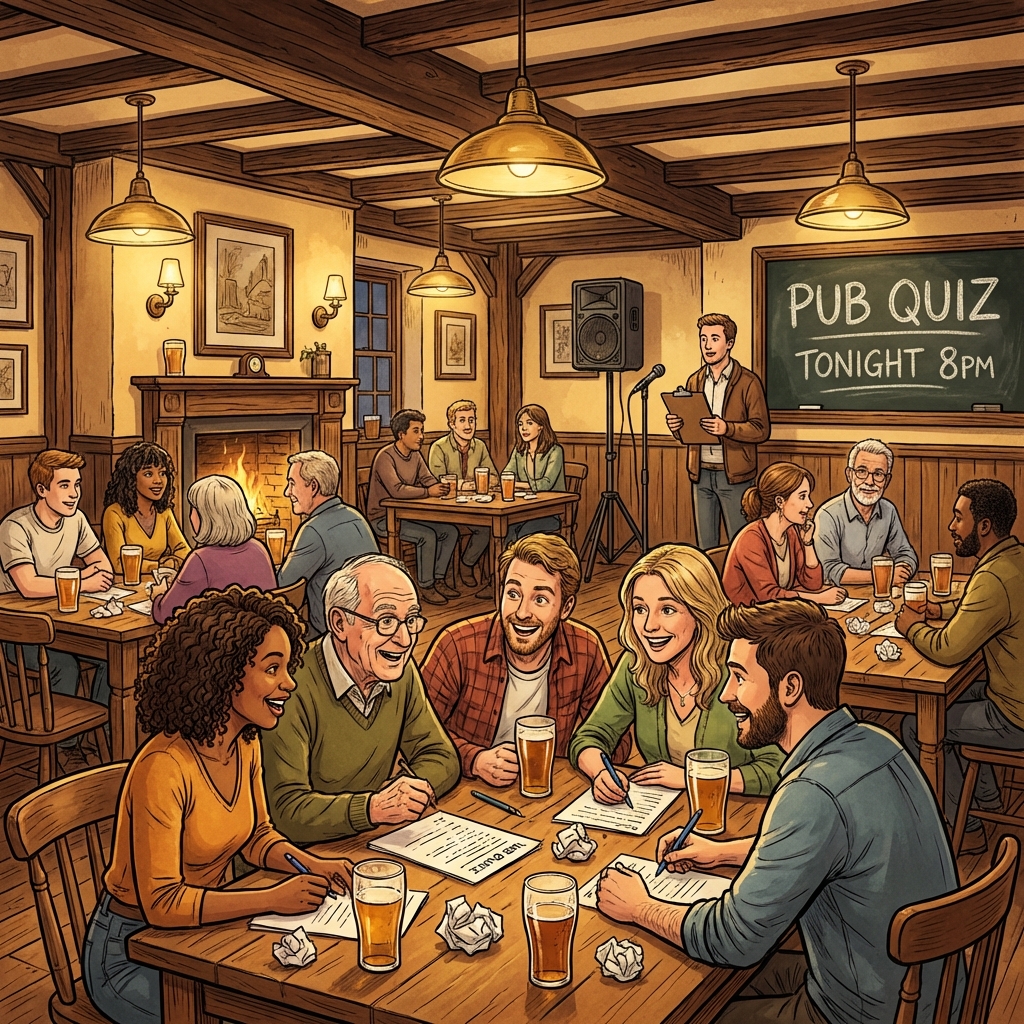
Picture this: It's 8 PM on a Tuesday evening. While the rest of the world winds down after work, British pubs are buzzing with an electric energy. Teams huddle around tables cluttered with pints, scrap paper, and well-worn pens. The quizmaster clears their throat. Silence falls. "Question one…"
Welcome to the pub quiz—a uniquely British institution that transforms ordinary midweek evenings into battlegrounds of knowledge, wit, and friendly rivalry.
What Makes Pub Quizzes So Special?
The pub quiz is deceptively simple: answer questions across various categories, compete against other teams, and (hopefully) win prizes. But beneath this straightforward format lies something far more profound—a social ritual that brings strangers together, tests friendships, creates legends, and keeps pubs alive on otherwise quiet weeknights.
Unlike solitary trivia apps or formal quiz shows, pub quizzes are participatory, communal, and delightfully unpredictable. They democratize knowledge—the Shakespeare scholar needs the football fanatic, the history professor relies on the pop culture obsessive, and the quiet engineer becomes a hero when the science round arrives.
Over 25,000 pub quizzes happen across the UK every week, with an estimated 500,000 people participating regularly. The industry generates approximately £500 million annually through increased food and drink sales, making quiz nights essential lifelines for struggling pubs.
A Brief History: From Pub Games to National Obsession
The Origins (1970s)
While informal quiz games existed in pubs for decades, the modern pub quiz was formalized in 1976 when Burns and Porter, a British leisure company, created a standardized format to help struggling pubs increase midweek trade. The concept was brilliantly simple: provide free quiz materials to landlords, who would then see increased beverage sales from teams spending 2-3 hours in the pub.
The timing was perfect. The 1970s saw massive growth in television ownership, and shows like "University Challenge" (1962-) and "Mastermind" (1972-) had already primed the British public to find quiz competitions entertaining and aspirational.
The Golden Age (1980s-1990s)
By the 1980s, pub quizzes had evolved into a national phenomenon. Trivial Pursuit's explosive popularity in 1981 further cemented trivia as mainstream entertainment. Pubs discovered that quiz nights not only generated revenue but created loyal customer communities—teams would return week after week, developing rivalries, traditions, and relationships.
The format standardized: typically 8-10 rounds covering General Knowledge, Sport, Music, History, Geography, Science, Entertainment, and often a Picture Round passed around tables. The Music Round evolved to include playing song clips, adding an auditory dimension.
The Digital Era (2000s-Present)
The 2000s brought technological innovations—digital buzzers, interactive screens, music streaming for perfect audio rounds—but also challenges. The smartphone revolution initially threatened to "ruin" pub quizzes through easy cheating, forcing quizmasters to implement "phones away" policies and design questions that Google couldn't easily answer.
Paradoxically, the same digital technology that threatened quizzes also saved them. Apps like Zoom Quiz Live during COVID-19 kept the tradition alive during lockdowns, with virtual pub quizzes becoming a family ritual nationwide. Many continued post-pandemic, creating hybrid in-person/virtual formats.
By 2024-2026, pub quizzes are experiencing a renaissance—younger generations seek offline social experiences, and the format's accessibility (low cost, no membership fees, intellectual stimulation) makes it perfect for our current cultural moment.
Anatomy of the Perfect Pub Quiz
The Rounds
General Knowledge – The backbone. Expect eclectic questions spanning history, geography, current events, and "common knowledge" that isn't always common. Sample: "Which planet is closest to the Sun?" (Mercury) or "What year did the Berlin Wall fall?" (1989).
Sport – A divisive round. Football dominates British quizzes, but expect cricket, rugby, tennis, athletics, and occasionally darts or snooker. Love it or hate it, sport rounds can swing entire competitions—teams with a dedicated sports expert have a significant edge.
Music – Often split into "Name That Tune" (identifying songs from clips) and music trivia ("Which band released 'Paranoid Android'?"). Generational battles emerge here—Boomers ace the 60s/70s, Gen X owns 80s/90s rock, Millennials dominate 00s indie, Gen Z knows TikTok viral hits.
Picture Round – Sheets with celebrity faces, landmarks, flags, or thematic images pass around tables. Allows quiet discussion while other rounds proceed. Often themed: "Actors Who Played Bond Villains" or "European Capital Cities from Above."
Specialist Rounds – History, Science, Literature, TV & Film, or hyper-specific topics like "1990s Football Managers" or "Shakespearean Death Scenes." These rounds reveal the depth (or limits) of your team's knowledge.
Wildcard/Bonus – The joker round. Teams can double points by designating one round as their "specialist subject" before it's announced. High risk, high reward—guess wrong and waste your advantage.
The Quizmaster
A good quizmaster is part entertainer, part referee, part psychologist. They must:
- Project authority – Maintaining order among competitive, lubricated crowds
- Deliver humor – Lightening tension, building rapport, turning mistakes into moments
- Ensure fairness – Adjudicating disputes over "technically correct" answers
- Read the room – Adjusting difficulty, pacing, and tone based on audience energy
- Command presence – Speaking clearly, projecting confidence, keeping time
Legendary quizmasters become local celebrities. Regulars know their quirks—the tendency to favor obscure 1980s snooker questions, the soft spot for Beatles trivia, the way they raise an eyebrow when a team is suspiciously correct.
The best quizmasters have personality. They banter with teams, roast incorrect answers gently, and celebrate brilliant guesses. They're not just reading questions—they're performing.
The Teams
Team Size: Typically 4-6 people for optimal dynamics. Too few, and knowledge gaps hurt. Too many, and coordination chaos ensues—seven people all shouting different Capital cities is nobody's idea of fun.
Team Names: An art form unto itself. The best are puns, pop culture references, or topical jokes. Classic examples:
- "Quiz Khalifa"
- "Let's Get Quizzical"
- "The Universally Challenged"
- "Norfolk and Chance"
- "Agatha Quiztie"
- "Guns 'N' Moses"
Topical names shine: during the 2012 Olympics, "Usain Bolts (From the Pub After This)" won many "Best Team Name" prizes.
The Prizes
Usually modest but meaningful: £50-100 bar tab, bottles of wine, boxes of chocolates, or simply bragging rights and having your team name on the "Winners Board" until .
The real prize is glory and validation. Winning a pub quiz provides a dopamine hit that lasts until at least Wednesday morning. It's proof that all those hours watching documentaries and reading Wikipedia weren't wasted—you ARE smart, actually.
The Social Dynamics: Why We Really Go to Pub Quizzes
Ostensibly, we go to test our knowledge and win prizes. Actually, we go for far deeper reasons:
Belonging
Quiz teams become micro-communities. You have "your" seats, "your" night, "your" people. In an atomized, digital age, this analog social ritual provides structure, consistency, and human connection.
Missing quiz night feels wrong—like skipping Sunday dinner or forgetting someone's birthday. You're needed. Your team counts on you.
Identity
Pub quizzes allow us to perform our knowledge, signaling intelligence, cultural capital, and breadth of interests. Knowing the obscure answer—"The Scilly Isles!" when everyone else guessed Isle of Wight—provides social validation.
We curate our intellectual identities: "I'm the music person. She's the history expert. He knows all the sport." These roles matter.
Leveling
Age, profession, and education matter less than diverse knowledge. The retired postal worker beats the Oxford graduate on music rounds; the bartender knows more geography than the geography teacher.
It's meritocratic in the best way—your PhD doesn't help if you can't name the Seven Dwarfs. Practical, eclectic knowledge trumps formal credentials.
Competition
Humans crave competition in low-stakes, playful environments. Pub quizzes provide this perfectly—losing stings for about 30 minutes, but you'll be back for redemption.
The competition is intense but consequence-free. Nobody loses their job or relationship over finishing fourth. But in the moment? It matters. Every half-point counts.
Routine
Tuesday night at The Crown, 8 PM. The predictability is comforting. It's your third place—not home, not work, but somewhere you belong.
In uncertain times, the ritual of quiz night is an anchor. The world may be chaotic, but every Tuesday, you'll be at that same table, with those same people, answering questions about capital cities and 1980s one-hit wonders.
Famous Pub Quiz Moments & Legends
The "Kevin Spacey Incident" (2017) – The actor was spotted unexpectedly attending a pub quiz in South London, causing pandemonium when questions about his films appeared. Teams debated whether asking him directly constituted cheating.
The "Leicester City Bet" (2016) – A quiz team in Nottingham correctly predicted Leicester City would win the Premier League (5000/1 odds) in a "wildest sports predictions" bonus round months before it happened. They won £20 in vouchers. The bet would have won them £50,000.
The "Perfect Score Myth" – Despite claims, no verified perfect score (100%) exists in a professionally-run general knowledge pub quiz. The best teams hover around 85-90%. Anything higher suggests very easy questions or very suspicious activity.
The "Phone Scandal of 2009" – A team in Manchester was caught Googling answers in the toilet. Upon discovery, they were banned for life. Their team name? "We Never Cheat." The irony was not lost.
The "University Challenge Alumni" – Former contestants from the TV show occasionally enter pub quizzes and dominate so thoroughly that landlords have implemented "handicap systems" or banned them entirely. Knowledge inequality is real.
Modern Trends: How Pub Quizzes Are Evolving
Hybrid Formats
Post-COVID, many quizzes offer in-person AND online participation simultaneously, expanding access for those with mobility issues, childcare responsibilities, or living remotely. Zoom teams compete against pub teams in real-time.
Inclusivity Focus
Progressive quizmasters are diversifying questions beyond "Dead White Men" history and Eurocentric geography, including more:
- Women scientists, artists, and historical figures
- BIPOC cultural contributions
- Global South geography and history
- LGBTQ+ culture and achievements
- Disability representation
This makes quizzes more engaging for diverse audiences and educates participants on broader histories.
Interactive Technology
Apps like Kahoot and Sporcle Live bring gamification—live leaderboards, instant scoring, multimedia questions—blending digital convenience with pub atmosphere.
Some venues use digital buzzers and projected answer screens, making scoring transparent and adding visual excitement.
Niche Communities
Specialist quizzes attract passionate micro-communities:
- Dungeons & Dragons Lore Quizzes
- RuPaul's Drag Race Trivia Nights
- Formula 1 Deep-Cut Questions
- Doctor Who Marathon Quizzes
- Metal Music History Nights
These events combine fandom with quiz format, creating intense, knowledge-rich experiences.
Sober/Alternative Venues
Recognizing not everyone drinks, quizzes now happen in:
- Independent cafes
- Public libraries
- Community centers
- Alcohol-free bars
- University student unions
This expands accessibility and challenges the assumption that quiz nights require alcohol.
The Cultural Significance: Why Pub Quizzes Matter
In an era of:
- Social fragmentation (declining community ties, "bowling alone")
- Digital isolation (relationships via screens)
- Economic precarity (expensive entertainment inaccessible to many)
- Mental health crises (loneliness epidemic)
Pub quizzes offer:
- Affordable community (free entry or £1-2, plus drinks you'd buy anyway)
- Face-to-face interaction (analog, embodied, human)
- Intellectual stimulation (lifelong learning made fun)
- Intergenerational connection (18-year-olds quiz alongside 80-year-olds)
- Routine and belonging (your weekly tribe)
They're democratic—no membership fees, formal dress codes, or gatekeeping. They're accessible—no athletic ability, expensive equipment, or elite education required. And they're FUN—laughter, friendly trash talk, shared victories and defeats.
The pub quiz is more than trivia. It's a social technology that builds community, one Tuesday night at a time.
Theodore Charles
Culture & Entertainment EditorAn expert contributor to the Social for Life community, sharing insights on social activities and beyond.
Portsmouth: Britain's Naval City