Plymouth: Ocean City Rising

Britain's Ocean City
Stand on Plymouth Hoe and look south: nothing but Atlantic Ocean until Antarctica. This isn't metaphor—it's geography. Plymouth sits at England's southwestern tip, jutting into the sea, and every chapter of its 1,000+ year history has been written by waves, warships, and departure.
The Mayflower sailed from here in 1620, carrying Pilgrims to the New World. Francis Drake finished his game of bowls here in 1588 before defeating the Spanish Armada. Captain Cook departed on his Pacific voyages from Plymouth. The Royal Navy has called Plymouth home for over 300 years—Devonport Dockyard remains Western Europe's largest naval base.
Then World War II nearly erased it all. German bombers targeted Plymouth's naval base relentlessly—59 bombing raids destroyed 3,700 buildings and killed 1,200 civilians. Post-war, Plymouth rebuilt itself with controversial 1950s-60s Modernist planning—today, that mid-century architecture defines the city center.
Now, Plymouth is transforming again. £1 billion+ regeneration investment, a new National Marine Aquarium, Ocean Studios creative quarter, the ongoing Waterfront transformation, and recognition as Britain's Ocean City are reshaping this resilient, sea-battered, proudly independent coastal city.
The numbers: 262,000 residents (UK's 30th largest city), Devonport Dockyard (Western Europe's largest naval base), 5,000+ Royal Navy personnel stationed locally, University of Plymouth (18,000+ students), Mayflower 400 anniversary (2020), and 1,200+ WWII civilian deaths (one of England's most-heavily bombed cities).
This guide explores Plymouth's naval legacy, Mayflower history, wartime destruction and rebirth, marine science leadership, and why this ocean-facing city is rising again.
Plymouth's Naval Legacy: 300+ Years of Royal Navy
Devonport: Western Europe's Largest Naval Base
Devonport Dockyard (officially His Majesty's Naval Base, Devonport) is Plymouth's gravitational center.
Established: 1690s (over 300 years of continuous operation)
Size: 650 acres
Current role: Western Europe's largest naval base
Ships based here: Royal Navy frigates, destroyers, amphibious assault ships, submarines (nuclear-powered)
Personnel: 5,000+ Royal Navy, Royal Marines, civilian workers
Why Plymouth?
Geography. Plymouth Sound provides a deep natural harbor protected from Atlantic storms by a breakwater (built 1812-1841, one of the most impressive 19th-century engineering feats). Perfect for naval vessels.
What you can see:
Devonport Dockyard is active military, so public access is restricted. But from Mount Edgcumbe Country Park (across Plymouth Sound), you can see:
- Warships moored
- Historic dockyard buildings
- Submarine activity
Royal Navy presence:
Plymouth is a Royal Navy town. Thousands of personnel live locally, families shop in town, naval traditions permeate. Pubs near the dockyard are Navy pubs. The city's identity is inseparable from the fleet.
Francis Drake and the Spanish Armada (1588)
Sir Francis Drake—pirate to the Spanish, hero to the English—is Plymouth's most legendary figure.
The Bowls Game Legend:
In July 1588, Drake was playing bowls on Plymouth Hoe when news arrived: the Spanish Armada (130 ships, largest naval force ever assembled) was sailing up the English Channel to invade England.
Drake allegedly said: "There is time to finish the game and beat the Spaniards too."
He finished his game, then sailed out to help defeat the Armada—one of England's greatest naval victories.
True story? Probably embellished, but it captures Drake's audacious confidence and Plymouth's seafaring swagger.
Drake's earlier achievements:
- Circumnavigation (1577-1580): Second person to sail around the world (after Magellan)
- Raiding Spanish treasure ships: Made himself and Queen Elizabeth I staggeringly wealthy
- Knighted on the deck of the Golden Hinde (his ship—replica in London today)
Statue on Plymouth Hoe:
Bronze statue of Drake looking out to sea—Plymouth's symbolic guardian.
Captain Cook: Pacific Voyages from Plymouth
Captain James Cook departed Plymouth on August 26, 1768 aboard HMS Endeavour for his first Pacific voyage—the expedition that charted New Zealand, eastern Australia, and countless Pacific islands.
Plymouth wasn't Cook's birthplace (Yorkshire) but his point of departure—the last English soil his crew saw before years at sea.
Plymouth's role: Final provisioning port for Royal Navy exploration voyages. Ships stocked food, water, and supplies here before months-long ocean crossings.
The Mayflower: America's English Origin Story
1620: The Pilgrims' Departure
On September 6, 1620, the Mayflower departed Plymouth carrying 102 passengers—Puritan "Pilgrims" seeking religious freedom in the New World.
Why Plymouth?
The Mayflower originally sailed from Southampton with a sister ship (the Speedwell), but the Speedwell proved unseaworthy. Both ships diverted to Plymouth for repairs. The Speedwell was abandoned; the Mayflower continued alone.
Plymouth was the Pilgrims' last sight of England. Many would never see it again.
The voyage:
66 days across the Atlantic. Cramped, disease-ridden, terrifying. They landed at Plymouth Rock, Massachusetts (named after the English Plymouth)—establishing the Plymouth Colony, one of America's foundational settlements.
Plymouth's American connection:
This single voyage links Plymouth, England to American origin mythology. Every American schoolchild learns about "Plymouth Rock"—fewer realize it references this English port city.
Mayflower 400 (2020): Commemorating the Anniversary
2020 marked the 400th anniversary of the Mayflower voyage.
Mayflower 400 project:
- The Box (new museum, see below)
- Mayflower exhibitions
- Transatlantic cultural exchange with Plymouth, Massachusetts
- Public art, events, heritage trails
COVID-19 impact: The pandemic muted many planned celebrations, but infrastructure improvements (The Box museum) endure.
Mayflower Steps and The Barbican
The Mayflower Steps (on the Barbican waterfront) mark the traditional departure point of the Mayflower.
Historical accuracy: Debated—no one knows the exact mooring spot. But the symbolic location matters.
The Barbican:
Plymouth's historic quarter—the only part of old Plymouth that survived WWII bombing largely intact.
What's there:
- Cobbled streets, Elizabethan-era buildings
- Mayflower Museum (small, free, tells the Pilgrim story)
- Waterfront restaurants, fish markets
- Independent shops, galleries
- National Marine Aquarium (UK's largest aquarium)
Why visit: Best-preserved historic Plymouth. Atmospheric, maritime charm.
WWII: The City That Wouldn't Surrender
Britain's Most-Bombed City (After London)
The Plymouth Blitz (1941-1944):
Plymouth suffered 59 major bombing raids by the German Luftwaffe.
Why target Plymouth?
Devonport Dockyard—the Royal Navy's southwestern base. Crippling Plymouth meant crippling Britain's Atlantic naval operations.
The devastation:
- 1,200+ civilians killed
- 3,700 buildings destroyed
- City center almost entirely flattened
- 100,000+ people made homeless
Survival:
Despite the destruction, Devonport Dockyard never stopped operating. Ships were repaired, supplies loaded, convoys dispatched. Plymouth kept Britain's Atlantic lifeline alive.
Post-War Rebuilding: Controversial Modernist Vision
After WWII, Plymouth City Council faced a choice: rebuild the old medieval street plan, or reimagine the city entirely.
They chose radical transformation.
Sir Patrick Abercrombie (town planner) designed a Modernist city center:
- Wide boulevards replacing narrow medieval streets
- Geometric grid layout
- Concrete and glass architecture
- Pedestrian zones, green spaces
Result:
Plymouth's city center looks like 1950s-60s Modernist planning—wide streets, concrete buildings, minimal historic character.
Controversial then, controversial now:
Some celebrate it as bold, visionary urban planning. Others lament the loss of historic fabric. Plymouth's city center divides opinion sharply.
What's undeniable:
This is 20th-century urban planning history—for better or worse, Plymouth is one of England's most complete examples of post-war Modernist reconstruction.
The Box: Plymouth's New Museum Marvel
The Box (opened 2020, Mayflower 400 project):
Plymouth's transformed city museum and art gallery.
What it is:
£40 million redevelopment of Plymouth Museum, combining:
- City history (prehistoric to present)
- Cottonian Collection (rare books, manuscripts)
- Fine art (including Rembrandt, Reynolds)
- Natural history
- Mayflower 400 exhibitions
Why it's called "The Box":
The building itself—a striking contemporary addition to a historic core—resembles a modern "box" inserted into the older structure.
What to see:
- Mayflower and Plymouth Colony exhibits (400th anniversary focus)
- WWII Plymouth Blitz (harrowing photos, survivor testimonies)
- 16th-century Cottonian Collection (one of England's oldest libraries, narrowly escaped destruction)
- Natural history: Devon wildlife, geology
Entry: Free (some special exhibitions ticketed)
Review consensus: Excellent. Well-designed, engaging, free. Major cultural asset for Plymouth.
Plymouth Hoe: Where Drake Played Bowls
Plymouth Hoe (pronounced "hoe" like the garden tool) is a large public green space on the limestone clifftop overlooking Plymouth Sound.
What "Hoe" means: Old English for "high place" or "heel of land jutting into the sea."
What's here:
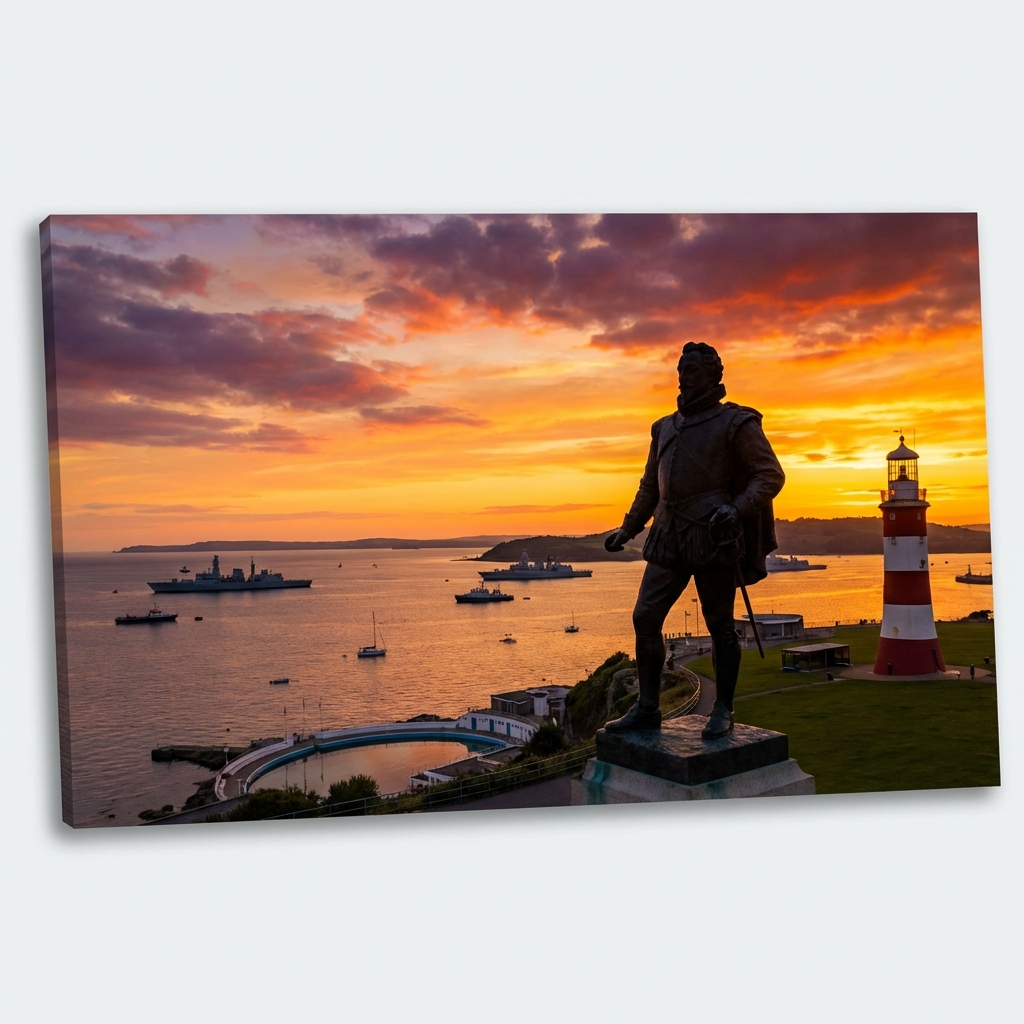
1. Smeaton's Tower:
Red-and-white striped lighthouse (1759, relocated to the Hoe after being replaced). Climbable—123 steps to panoramic views. £5 entry.
2. Drake's Statue:
Bronze statue of Sir Francis Drake gazing out to sea, bowling ball in hand.
3. Naval Memorial:
Obelisk commemorating Royal Navy personnel killed in WWI and WWII—over 23,000 names inscribed.
4. Views:
Spectacular 180-degree ocean views. Plymouth Sound, Drake's Island, the Breakwater, ships entering/leaving harbor.
5. Events:
The Hoe hosts summer events, festivals, outdoor cinema, fireworks.
Why visit: Essential Plymouth experience. Walk, picnic, fly kites, absorb ocean vastness. On clear days, you can see the Eddystone Lighthouse (14 miles offshore).
University of Plymouth: Marine Science Leader
University of Plymouth:
Established: 1992 (university status; polytechnic roots earlier)
Students: 18,000+
Why it matters:
Marine science and ocean research powerhouse:
Plymouth's location (Atlantic coast, natural harbor, proximity to marine habitats) makes it ideal for marine biology, oceanography, environmental science.
Reputation:
One of the UK's top universities for marine science, marine biology, ocean conservation research.
Student city:
18,000 students inject youth, energy, nightlife into Plymouth. University presence prevents Plymouth from becoming purely a naval/tourist town.
Plymouth Marine Laboratory (PML):
Separate research institution (not part of university but closely linked). World-leading marine research.
Ocean Studios: Creative Quarter Rising
Ocean Studios (Royal William Yard):
Plymouth's creative industries hub.
Location:
Royal William Yard—a stunning Grade I listed former Royal Navy victualling depot (built 1826-1835). Where the Navy stored food supplies for ships.
Today:
The Yard has been converted into:
- Ocean Studios (60+ creative businesses—designers, artists, filmmakers, tech startups)
- Residential apartments
- Restaurants, cafés, bars
- Wedding/event venues
Ocean Studios specifically:
Collaborative workspace for creative professionals. Think WeWork but specifically arts/media/design focused.
Why it works:
Beautiful historic buildings + waterfront location + affordable studio space = thriving creative cluster.
Similar UK transformations:
Bristol's Tobacco Factory, Liverpool's Baltic Triangle, Manchester's Northern Quarter—post-industrial spaces reborn as creative quarters.
National Marine Aquarium: UK's Largest
National Marine Aquarium (The Barbican):
UK's largest aquarium and Europe's deepest tank (10 meters).
What's inside:
- Ocean tank: Sharks, rays, sea turtles
- British waters: Local marine life (often overlooked but fascinating)
- Coral reef displays
- Plymouth Sound exhibit: Creatures from local waters
Conservation focus:
Not just entertainment—serious marine conservation messaging, ocean health education, breeding programs.
Entry: £16-20 (book online for discounts)
Family-friendly: Excellent for kids
Why visit: World-class aquarium showcasing Plymouth's marine environment and global ocean biodiversity.
Practical Guide: Visiting Plymouth
Getting There
By Train:
- From London Paddington: 3-3.5 hours (direct GWR service)
- From Bristol: 2 hours
- From Exeter: 1 hour
By Car:
- M5 from Midlands/North (then A38 to Plymouth)
- A38 from Exeter (1h 15min)
By Ferry:
- Brittany Ferries: Plymouth-Roscoff (France), Plymouth-Santander (Spain)—Plymouth is an international port
One Perfect Day in Plymouth
Morning (9:30am-12pm):
- The Box museum (2+ hours, free, excellent)
- Walk to Plymouth Hoe, see Drake statue, Smeaton's Tower
Lunch (12-1:30pm):
- The Barbican waterfront (fish & chips at Barbican Kitchen or similar)
Afternoon (1:30-5pm):
- National Marine Aquarium (2 hours)
- Stroll The Barbican cobbled streets, Mayflower Steps, Elizabethan buildings
- OR walk Royal William Yard (if prefer architecture/creative spaces)
Evening:
- Sunset on Plymouth Hoe (spectacular)
- Dinner: Barbican waterfront or Royal William Yard restaurants
Optional add-ons:
- Mount Edgcumbe Country Park (ferry across Plymouth Sound, gorgeous parkland, views back to city)
- Dartmoor National Park (30 minutes north—wilderness, tors, Sherlock Holmes' Hound of the Baskervilles setting)
When to Visit
Best: May-September (warmest, longest days, outdoor Hoe activities)
Events: British Fireworks Championships (August, Plymouth Hoe—spectacular)
Avoid: November-February (cold, windy, exposed coastal location)
Where to Stay
Budget: Travelodge, Premier Inn (city center)
Mid-Range: Duke of Cornwall Hotel (historic, central)
Waterfront: Crowne Plaza (harbor views)
Unique: Royal William Yard apartments (Airbnb, converted Navy buildings)
Cornwall and Dartmoor: Day Trips from Plymouth
Dartmoor National Park (20 minutes north)
368 square miles of wild moorland:
- Granite tors (rocky hilltops)
- Prehistoric remains (stone circles, burial cairns)
- Wild ponies roaming free
- Hound of the Baskervilles setting (Sherlock Holmes novel)
Activities: Hiking, climbing tors, visiting villages (Princetown, Widecombe)
Must-see: Hay Tor (iconic granite outcrop, easy hike, panoramic views)
Cornwall (30 minutes west)
Plymouth sits on the Devon-Cornwall border.
Nearby Cornwall highlights:
- Looe (pretty fishing village, 25 min)
- Polperro (even prettier, car-free village, 35 min)
- Eden Project (biomes, gardens, 40 min)
- Fowey (sailing town, literary connections—Daphne du Maurier, 45 min)
South Devon Coast
East of Plymouth:
- Salcombe (upmarket sailing town, gorgeous estuary, 1h)
- Dartmouth (historic naval town, stunning river, 1h)
Conclusion: The City That Faces the Ocean
Plymouth doesn't look inland. It never has.
When Francis Drake saw the Spanish Armada, he looked south. When the Mayflower Pilgrims said goodbye to England, they looked west across the Atlantic. When German bombers tried to destroy the dockyard, Plymouth rebuilt and kept looking to the sea.
Today, Plymouth is rising again—The Box museum puts its history on display, Ocean Studios channels creativity into converted Navy buildings, the waterfront regeneration continues, and Britain's Ocean City branding embraces what Plymouth has always been: England's maritime soul.
Yes, the Modernist city center divides opinion. Yes, it rains a lot. Yes, it's far from London (and proudly so).
But stand on Plymouth Hoe at sunset, watch the Atlantic turn gold, see Royal Navy ships slip past the Breakwater, feel the salt wind, and you'll understand: Plymouth isn't trying to be anywhere else. It's entirely, stubbornly, gloriously itself.
Ocean-facing. History-soaked. Rising.
References and Resources
Official Tourism
Visit Plymouth: visitplymouth.co.uk
Events, attractions, accommodation
Key Attractions
The Box: theboxplymouth.com
Museum, art gallery, Mayflower 400 (free entry)
National Marine Aquarium: national-aquarium.co.uk
UK's largest, conservation focus (£16-20)
Plymouth Hoe: plymouthwaterfront.com
Public green space, Drake statue, Smeaton's Tower
Royal William Yard: royalwilliamyard.com
Ocean Studios, restaurants, historic Navy buildings
History & Heritage
Mayflower Museum: barbicantheatretrust.com/mayflower-museum
Small, free museum on The Barbican
Mount Edgcumbe: mountedgcumbe.gov.uk
Country park, ferry from Plymouth
University
University of Plymouth: plymouth.ac.uk
Marine science leader, 18,000+ students
Day Trips
Dartmoor National Park: dartmoor.gov.uk
Wild moorland, 20 min north
Eden Project (Cornwall): edenproject.com
Biomes, gardens, 40 min west
Transport
Great Western Railway: gwr.com
London-Plymouth trains (3-3.5h)
Brittany Ferries: brittany-ferries.co.uk
Plymouth-France/Spain services
Featured Image Suggestion: Plymouth Hoe at sunset—Drake statue silhouetted against golden sky, Plymouth Sound and naval ships in the distance. Dramatic, maritime, captures ocean city essence.
Timothy Canon
History & Literature CriticTimothy writes about history, literature, and the cultural threads that connect past and present.