Exeter: Cathedral City and Student Hub

The Ancient City That Feels Forever Young
Exeter is a paradox.
It is one of England's oldest cities—a Roman fortified capital, a medieval religious powerhouse, a Tudor trading port. You can walk on 2,000-year-old Roman walls, explore underground medieval passages, and stand beneath the world's longest uninterrupted Gothic vaulted ceiling in its breathtaking cathedral.
Yet Exeter feels incredibly young.
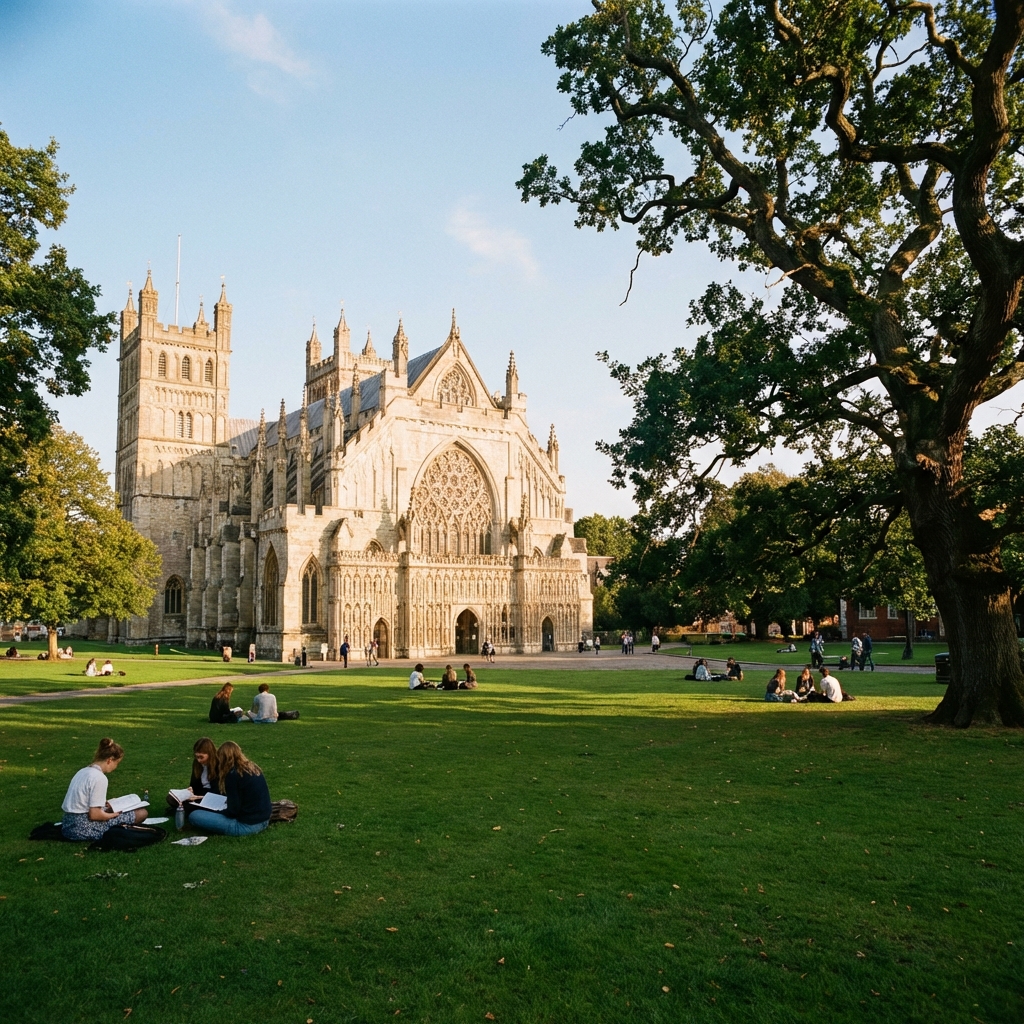
With 25,000 students (in a city of 130,000) attending the University of Exeter (a Russell Group heavyweight), the city pulses with youthful energy. Independent coffee shops, vibrant arts venues, a bustling quayside, and a progressive vibe balance the ancient stone. It's a city where students revise for exams on the lawn of a 900-year-old cathedral, and where Roman ruins sit beneath a modern shopping center.
The numbers: 130,000 residents, 25,000 students, 2,000 years of history, 70% of Roman wall surviving, 1 magnificent cathedral, and minutes from Dartmoor and the coast.
This guide explores Exeter's unique blend of ancient heritage and modern student culture—a city that honors its past while sprinting toward the future.
Exeter Cathedral: A Gothic Masterpiece
The Heart of the City
Exeter Cathedral (officially the Cathedral Church of Saint Peter) doesn't just sit in the city center; the city seems to orbit around it.
Built: 1114-1400
Style: Norman (towers) and Decorated Gothic (main body)
Towers: The two massive square towers are the oldest part (Norman, 1114-1133)—unique because they sit on the sides (transepts) rather than the center or west end.
Why it's world-class:
1. The Vaulted Ceiling:
Look up. The nave ceiling is the longest uninterrupted medieval vaulted ceiling in the world (96 meters / 315 feet). A spine of stone ribs running the entire length. Breathtaking engineering.
2. The West Front:
The exterior wall is covered in image screen sculptures—kings, apostles, prophets, angels. Originally brightly painted, now weathered stone, but still an incredible medieval gallery.
3. The Bishop's Throne:
Made of Devon oak in 1312. It's 18 meters tall—without a single nail. The wood has lasted 700+ years.
4. The Astronomical Clock:
Dating from 1484. It shows the sun orbiting the earth (pre-Copernicus!). The door below has a small hole for the cathedral cat (even in the 15th century, cats needed access to catch mice).
Visiting:
- Entry £7.50 (students cheaper/free)
- Cathedral Green: The grassy lawn surrounding it is Exeter's "living room"—students, locals, office workers eating lunch in the shadow of Gothic majesty.
Roman Exeter: Isca Dumnoniorum
The Frontier City
Exeter was the most westerly Roman city in Britain. They called it Isca Dumnoniorum ("Water of the Dumnonii tribe").
The City Walls:
Around 70% of the Roman city wall still stands. You can walk significant stretches. It defined the city's shape for 1,500 years.
The Underground Passages:
Exeter's most unique attraction. Originally medieval aqueducts built to bring fresh water into the city, they run beneath the streets.
- Guided tours: Put on a hard hat and walk underground.
- History: Used as air raid shelters during WWII.
- Experience: Dark, narrow, fascinating.
Royal Albert Memorial Museum (RAMM):
Award-winning museum housing Exeter's Roman artifacts, mosaics, and history. Free entry.
The University of Exeter: Shaping the City
Russell Group Excellence
The University of Exeter isn't just a school; it's the city's economic and cultural engine.
Rankings: Consistently top 15 in UK, Russell Group member
Campuses:
- Streatham Campus: Often voted the "most beautiful campus in the UK"—botanic gardens, hills, views, modern architecture mixed with Italianate halls.
- St Luke's Campus: Historic, central, home to medicine and sport science.
Student Impact:
- Demographics: 25,000 students keep the average age young.
- Economy: Student spending supports the independent café/bar scene.
- Culture: The Northcott Theatre (on campus) is a major regional venue.
Famous Alumni:
- J.K. Rowling (studied French & Classics; allegedly based locations in Harry Potter on Exeter sights—Gandy Street = Diagon Alley? The Old Fire House = Leaky Cauldron? Debated, but legendary.)
- Thom Yorke (Radiohead)
- Vanessa Kirby (The Crown)
Historic Quayside: From Wool Port to Leisure Hub
Exeter's Waterfront Renaissance
Just ten minutes downhill from the cathedral lies the Quayside.
History:
Once a bustling port exporting wool cloth (Exeter was wealthy from wool, like Ipswich and Norwich).
Today:
Exeter's leisure destination.
- Converted warehouses: Antique centers, craft workshops, restaurants
- The Custom House: Oldest brick building in Exeter (1680)
- Activities: Hire bikes, rent kayaks/canoes to paddle the Exeter Ship Canal or River Exe
- Vibe: Sunny afternoons, riverside drinks, swans, relaxed atmosphere
Recommended:
Rent a bike and cycle to the Double Locks or Turf Hotel pubs along the canal. Flat, scenic, perfect afternoon.
Gandy Street: The "Harry Potter" Street
Gandy Street is a narrow, cobbled lane filled with independent shops, bars, and restaurants.
The Legend:
Heavily rumored to be the inspiration for Diagon Alley in Harry Potter (J.K. Rowling studied here). Whether true or not, it feels magical—quirky buildings, narrow vibe.
What's there:
- Exeter Phoenix: Arts center, gig venue, cinema
- The Cauldron Inn: Harry Potter-themed bar (leaning into the legend)
- Coolings: Historic cellar bar
The Old Fire House: Exeter's Best Pub?
Ask any student or local: "Where should I get a drink/pizza?" Answer: "The Old Fire House."
Why:
- Massive rectangular pizzas (legendary value)
- Candlelit, rustic atmosphere
- Huge cider selection
- Allegedly the inspiration for the Leaky Cauldron (again, Rowling mythos)
It's an institution. Must-visit.
Practical Guide: Visiting Exeter
Getting There
By Train:
- From London Paddington: 2h - 2h 30min (GWR)
- From London Waterloo: 3h 20min (slower but cheaper route via SWR)
- From Bristol: 1 hour
- From Plymouth: 1 hour
By Car:
- M5 motorway ends at Exeter (Junction 31). Gateway to the South West.
Exeter Airport: Flights to UK/Europe destinations.
One Perfect Day in Exeter
Morning (9:30am-12pm):
- Exeter Cathedral (tour inside, relax on the Green)
- Royal Albert Memorial Museum (RAMM) (free, award-winning)
Lunch (12-1:30pm):
- Gandy Street or Cathedral Green café
Afternoon (1:30-5pm):
- Walk down to Historic Quayside (15 min walk)
- Rent a canoe or bike, or browse antique shops
- Underground Passages tour (book ahead!)
Evening:
- Dinner/Drinks: The Old Fire House (pizza & cider)
- Arts: Check Exeter Northcott or Exeter Phoenix for shows
When to Visit
Best: May-June (students finishing exams, campus beautiful, weather good)
September-October (new academic year energy, autumn colors)
Avoid: Late July-August (students gone, feels quieter, though tourists present)
Where to Stay
Budget: Premier Inn, Holiday Inn Express
Boutique: Hotel du Vin (in a former eye hospital!)
Luxury: Lympstone Manor (nearby, Michelin star)
The Turk's Head: (historic pub with rooms, next to Guildhall)
Day Trips: Dartmoor and the Coast
Exeter is the perfect base because it sits between the moor and the sea.
Dartmoor National Park (20-30 mins west)
Wild, rugged granite landscape. Ponies, tors, hiking.
- Haytor: Iconic rock formation
- Widecombe-in-the-Moor: Picture-perfect village
The Jurassic Coast (20-30 mins south/east)
UNESCO World Heritage coastline.
- Exmouth: Long sandy beach, start of Jurassic Coast
- Sidmouth: Regency seaside town, red cliffs
- Topsham: Charming estuary town (accessible by train/bike from Exeter)
Conclusion: The Perfect Balance
Exeter manages a difficult trick: it respects its history without being trapped by it.
It cherishes the Roman wall and the Gothic cathedral, but it lives in the independent coffee shops, the university laboratories, and the riverside cycle paths. It's a city small enough to walk across in 20 minutes, yet big enough to have a national museum, a major university, and a distinct cultural identity.
Sit on the Cathedral Green on a sunny afternoon. Watch the mix of tourists admiring the Norman towers and students debating essays on the grass. That's Exeter.
Ancient foundations. Young spirit.
References and Resources
Official Tourism
Visit Exeter: visitexeter.com
Events, accommodation, guides
Key Attractions
Exeter Cathedral: exeter-cathedral.org.uk
Opening times, tours, events
Royal Albert Memorial Museum (RAMM): rammuseum.org.uk
Free entry, collections
Underground Passages: exeter.gov.uk/passages
Tour booking (essential)
University
University of Exeter: exeter.ac.uk
Campus info, arts events
Venues
Exeter Phoenix: exeterphoenix.org.uk
Arts, music, cinema
Exeter Northcott Theatre: exeternorthcott.co.uk
Regional theatre on campus
Food & Drink
The Old Fire House: oldfirehouseexeter.co.uk
Legendary pizza & cider
Transport
Great Western Railway: gwr.com
Trains to London/Bristol/Plymouth
South Western Railway: southwesternrailway.com
Trains to London Waterloo
Featured Image Suggestion: (Image generated and ready) Wide landscape view of Exeter Cathedral and Cathedral Green, students relaxing on grass, ancient oak framing the Gothic architecture.
Timothy Canon
History & Literature CriticTimothy writes about history, literature, and the cultural threads that connect past and present.