The Commodore 64: The Computer That Defined a Generation

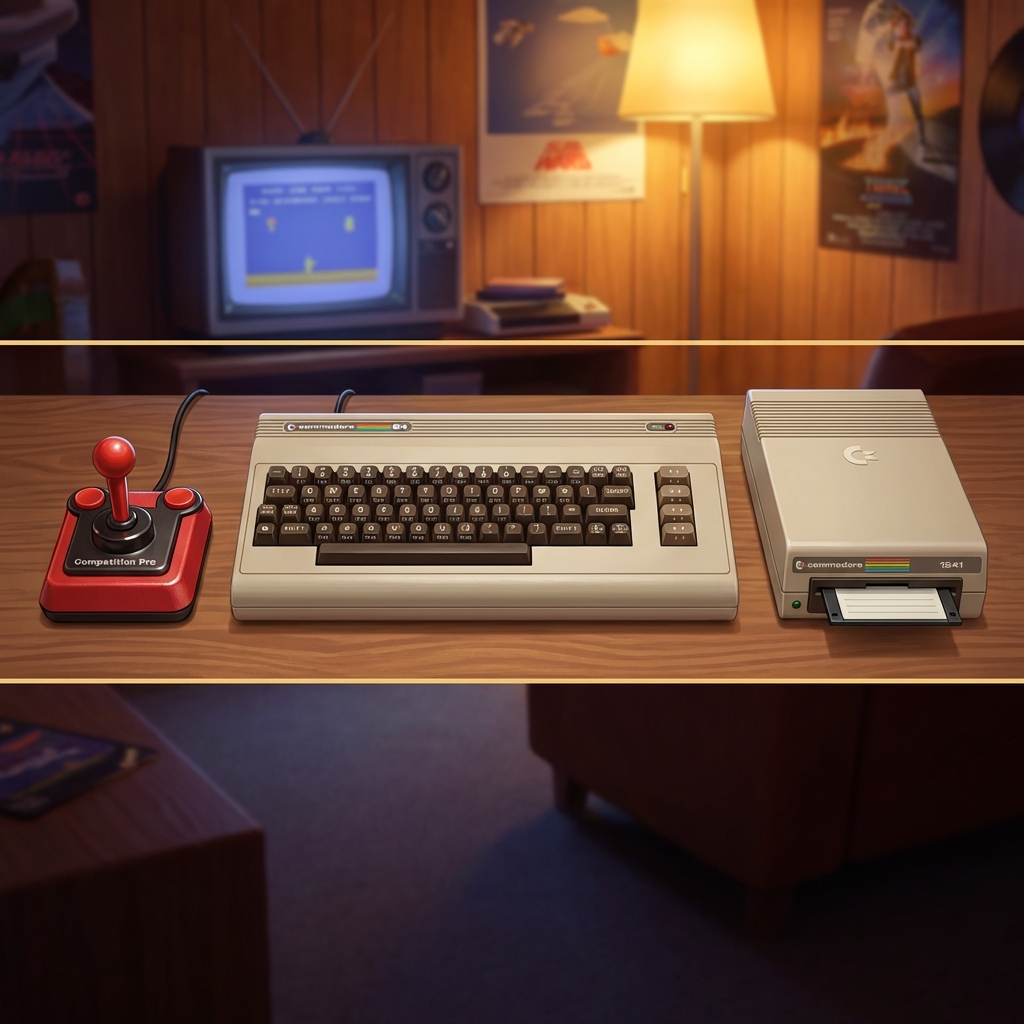
The Machine That Brought Computing to the Masses
Between 1982 and 1994, the Commodore 64 sold an estimated 12.5 to 17 million units, making it the best-selling single computer model of all time—a record that still stands in the Guinness Book of Records. This wasn't just a computer; it was a cultural phenomenon that introduced millions worldwide to programming, gaming, and the digital future.
If you grew up in the 1980s or early 90s, chances are you either owned a C64, knew someone who did, or desperately wanted one. The distinctive beige "breadbin" case, the rainbow Commodore logo, and that mesmerizing loading screen with the psychedelic colors—these are burned into the memory of a generation.
Historical Context: The Home Computer Revolution
The Pre-C64 Era (1977-1981): The Pioneers
The home computer revolution began with the Commodore PET (1977), Apple II (1977), and Tandy TRS-80 (1977)—the "1977 Trinity." These machines proved consumers wanted computers at home, but they were expensive (£1,000+) and primarily aimed at hobbyists and businesses.
In the UK, Sinclair's ZX80 (1980) and ZX81 (1981) demonstrated there was massive demand for affordable home computers. The ZX81 sold over 1.5 million units at just £49.95. Across the pond, Commodore founder Jack Tramiel was watching carefully, preparing his killer response.
The C64 Era (1982-1992): Total Dominance
Launched in August 1982 at $595 (about £400), the C64 had superior graphics and sound to anything in its price range. Commodore's aggressive pricing strategy—dropping to $199 by 1983—triggered the Home Computer Price War that killed competitors like Texas Instruments and Atari's computer division.
The peak years were 1983-1986 when the C64 outsold everything else combined. Game developers flocked to the platform. Magazine racks groaned under the weight of C64 publications. Type-in program listings filled thousands of pages, with kids spending hours entering BASIC code from magazines.
By 1983, Commodore was selling 2 million C64s per year. The company's slogan "Are you keeping up with the Commodore?" became ubiquitous in advertising.
Decline and Legacy (1993-Present): Immortality
By the early 90s, Amiga and PC clones were taking over. The 16-bit era had arrived. Commodore International declared bankruptcy in April 1994, a tragic end to a pioneering company. But the C64 never truly died—a passionate community kept it alive, and today it's more celebrated than ever.
In 2024-2026, new C64 games are still being released. The demoscene continues to push the hardware to impossible limits. Retro gaming shows feature C64 setups. The legend lives on.
🖥️ Technical Specifications: Revolutionary for Its Time
The Powerhouse Inside
- CPU: MOS Technology 6510 (6502 variant) @ 1.023 MHz (NTSC) / 0.985 MHz (PAL)
- RAM: 64 KB (hence the name) with 38 KB available to BASIC programs
- ROM: 20 KB (BASIC, KERNAL, character set
- Graphics: VIC-II chip with 320×200 resolution, 16 colors, 8 hardware sprites, smooth scrolling
- Sound: The legendary SID chip (6581/8580) with 3-channel synthesizer capabilities
- Storage: Cassette tapes (Datassette 1530) or 5.25" floppy disks (1541 drive)
- Ports: Cartridge port, 2× joystick/paddle ports, serial, user port, RF & composite video
What Made It Special
The SID sound chip (6581) was years ahead of competitors. While other computers beeped and blooped, the C64 produced rich, synthesized music that rivaled dedicated synthesizers costing thousands. Legendary composers like Rob Hubbard, Martin Galway, and Ben Daglish created soundtracks that are still remixed and performed at concerts today.
The VIC-II graphics chip enabled smooth-scrolling arcade-style games that embarrassed competitors. Those colorful sprites, the smooth parallax backgrounds, the hardware-assisted collision detection—the C64 was a gaming beast disguised as a productivity computer.
🎮 The Games That Defined It
The Classics Everyone Remembers
- The Last Ninja (1987): System 3's isometric martial arts epic with groundbreaking graphics and atmosphere
- Boulder Dash (1984): First Star's addictive puzzle game spawned countless clones and sequels
- Impossible Mission (1984): "Another visitor. Stay a while... STAY FOREVER!" - Digitized speech on a home computer!
- Elite (1984): The original space trading simulator with 3D wireframe graphics in 22 KB
- International Karate (1985): System 3's martial arts perfection with Rob Hubbard's iconic soundtrack
- Paradroid (1985): Andrew Braybrook's innovative robot-blasting action
- Uridium (1986): Silky smooth horizontal shooter pushing the hardware
- Wizball (1987): Sensible Software's physics-based shooter with Martin Galway's music
The Loading Experience
If you had a Datassette, you know the ritual:
- Type LOAD"",1,1 or LOAD"*",8,1 for disk
- Press PLAY on TAPE (cassette) or hit RETURN (disk)
- Wait 5-10 minutes watching the psychedelic loading screen border cycle through colors
- Pray it doesn't encounter a read error
- If it fails, rewind and try again
The 1541 disk drive was faster (2-3 minutes) but almost cost as much as the computer itself (£200+). The drive had its own 6502 CPU and became legendary for its unreliability and weird noises.
💾 Programming: A Nation of Bedroom Coders
BASIC Built In
Turn on a C64, and you're greeted with the blue screen, the friendly "**** COMMODORE 64 BASIC V2 ****" message, and the blinking cursor. The Commodore BASIC 2.0 interpreter was ready to go. Thousands of kids learned to program by typing in listings from magazines like COMPUTE!'s Gazette and Zzap!64.
Simple programs like:
10 PRINT "HELLO WORLD"
20 GOTO 10
Led to more complex adventures in sprite manipulation, sound generation, and game creation.
Machine Code Wizardry
Serious programmers moved to 6502 assembly language. Tools like Turbo Assembler, SEUCK (Shoot'Em-Up Construction Kit), and later Turbo Macro Pro enabled bedroom coders to create commercial-quality games.
Programmers like Andrew Braybrook, Jon Hare, and Chris Hülsbeck started as bedroom coders and became industry legends.
📚 The Magazine Era
Essential Reading
- Zzap!64 (UK, 1985-1992): The definitive C64 magazine with witty reviews, high production values, and the "Zzap! Sizzler" award
- COMPUTE!'s Gazette (US, 1983-1995): Type-in programs and serious programming tutorials
- Commodore User (UK, 1983-1990): Coverage of the entire Commodore ecosystem
- Commodore Format (UK, 1990-1995): The UK's last dedicated C64 magazine, keeping the flame alive
- RUN Magazine (US, 1984-1992): Programs, reviews, and hardware hacks
🎵 Music and the Demoscene
SID Music Lives Forever
The C64's music scene is legendary. The High Voltage SID Collection (HVSC) contains over 55,000 SID music files—a testament to the chip's enduring appeal. Artists like Rob Hubbard, Martin Galway, and later Jeroen Tel created masterpieces within the 3-channel limitations.
Modern musicians still use the SID chip sound. The 8-bit Music Theory YouTube channel has millions of views analyzing C64 music composition techniques.
The Demoscene
The Commodore demoscene pushed the hardware beyond what developers thought possible. Demo groups like Booze Design, Fairlight, Crest, and Oxyron created non-interactive audiovisual experiences showcasing impossible effects—bitmap zooming, full-screen pictures updating in real-time, and music synchronized to visuals.
The annual X Party in the Netherlands still celebrates C64 demos, with competitions for "best graphics," "best music," and "best demo."
🔗 Resources & Where to Learn More
Essential Links
- C64 Wiki - Comprehensive encyclopedia of everything C64
- Lemon64 - Complete game database with reviews and ratings
- High Voltage SID Collection - Every SID tune ever created, archived
- CSDb (C64 Scene Database) - Demoscene archive and release tracker
- Internet Archive C64 Collection - Play thousands of games in your browser
- TheC64 - Official modern mini console by Retro Games Ltd
- Ultimate Commodore 64 Reference - Technical documentation
✨ Experience the C64 Today
1. Get Emulating
VICE (Versatile Commodore Emulator) is free, open-source, and runs on Windows, Mac, Linux, and even Android/iOS. Download it, grab some disk images from legal sources, and load up Boulder Dash or The Last Ninja to relive the magic.
2. Buy TheC64
Retro Games Ltd makes TheC64 (full-size keyboard) and TheC64 Mini (compact)—modern HDMI versions preloaded with 64 classic games. Plug into your TV and play authentic recreations.
3. Join the Community
Check our Groups page for local retro computing clubs. Share technical knowledge, swap hardware, trade disk images, and celebrate the legendary machine with fellow enthusiasts.
4. Attend Retro Gaming Events
Browse Events for retro gaming expos, C64 demo parties, SID music concerts, and vintage computer fairs happening near you.
5. Visit Retro Computing Museums
Explore Places featuring computing museums with working C64s on display, including the Centre for Computing History in Cambridge and the National Museum of Computing at Bletchley Park.
Why the C64 Still Matters
The Commodore 64 democratized computing. It proved that powerful technology could be affordable and accessible. It created a generation of programmers who went on to build the modern tech industry—many game developers, software engineers, and tech entrepreneurs cite the C64 as their inspiration.
The machine taught problem-solving within constraints. With only 64 KB of RAM and a 1 MHz processor, programmers had to be creative, efficient, and ingenious. These skills translated directly into professional careers.
In 2024-2026, the C64 scene is more vibrant than ever. New games are released monthly on platforms like itch.io. The demoscene continues to push boundaries—the 2024 release "Edge of Disgrace" by Booze Design features effects that experts said were impossible. SID music concerts sell out venues across Europe. Annual meetups like LOAD ERROR in Sweden attract hundreds of fans.
Ready to join the C64 family? Whether you're rediscovering your childhood or experiencing it for the first time, there's never been a better time to appreciate the computer that changed everything. The community is welcoming, the games are timeless, and the music is unforgettable.
Julian Cross
An expert contributor to the Social for Life community, sharing insights on lifestyle and beyond.